April Newsletter
This month’s newsletter holds a lot, and I mean that as a statement of purpose, not just volume. When I look at what WE’RE has been doing this spring, from our Health Access Convening to the LDP Closing Ceremony to our upcoming ERG Spring Summit, I see a coalition that is trying to hold two truths at once: that belonging and leadership development are urgent and necessary, and that the conditions in which people are trying to lead and thrive are getting harder. The Washington Roundtable’s recently released Prices We Pay report names what many of our employees and their families are living: Washington is now the fifth most expensive state in the nation, with costs rising faster than anywhere else over the past decade. Housing and utility costs are up 62 percent since 2015. Food is up 50 percent. And this is not a Seattle problem, every one of Washington’s twelve metro areas falls within the top 25 percent nationally for cost of living. That data is not background noise. It is the context in which every conversation we are having about workforce development, retention, and inclusion must be understood. When we talk about what it takes for people to stay and thrive, which is exactly what Geoffrey Cohen’s research at Fred Hutch named so powerfully, we have to be honest that belonging is harder to sustain when people are financially stretched, exhausted, and uncertain about their future. Which is precisely why this work matters more, not less. The LDP Cohort 4 participants who wrote that “change in the culture begins with us” and “we all have a seat at the table and something to learn from one another,” they were not speaking abstractly. They were speaking as people who showed up, week after week, and chose to invest in becoming the kind of leaders their teams and organizations actually need. That is an act of hope and it is exactly what WE’RE is here to support. As we prepare to launch an early-career professionals cohort this fall and continue building the infrastructure for our ERG Spring Summit in June, I want to name the through-line clearly: this coalition exists because Washington employers have a role to play not just in responding to the affordability crisis, but in building the workplaces where people want to stay, where they feel seen, developed, and valued. It is a workforce strategy, and it is the work we will keep doing, together.
ADVANCING HEALTH ACCESS
Aligning to Expand Care For All Communities
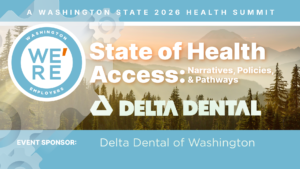
This spring, WE’RE gathered healthcare leaders, providers, insurers, and advocates for an honest and energizing conversation about health access in Washington State. The timing couldn’t have been more relevant.
Attendees named what so many are navigating right now: the pressure of federal and state funding shifts on the capital, capacity, and resources healthcare organizations need to serve growing community needs. What moved the room was the resilience in the room — organizations continuing to advance meaningful work despite disruption, focused not on the typical social determinants of health, but on reaching communities who lack access to quality care, coverage, and advocacy.
We were inspired by stories from the field, including Anna Franklin’s Maji Rising Project — a Spokane-based community dedicated to lineage-based healthcare, holistic healing, and a vision of equitable well-being — and the Groundwater Institute’s coalition work to get proximate to the root causes of systemic health inequity.
What emerged was clear: people need a place to convene, share, and hold each other up. We left with a shared commitment to do exactly that — combining resources, knowledge, and effort to improve systems for those furthest from access and opportunity.
In case you missed it, click the link to watch our video storytelling project. Watch for your invitation to a future convening.
A heartfelt thank you to Delta Dental of Washington and the championship of Diane Oaks, Arwa Dubad, David Carreon-Bradley, and Mark Mitchke for making this conversation possible.
Onward.
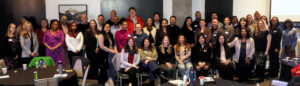
Leadership Development Cohort 4 Closing Ceremony
What Happens When Leaders Do the Inner Work
Something different happens when a leadership program asks more of its participants than attention and attendance. WE’RE’s Leadership Development Program, a rigorous, eleven-week cohort built in partnership with faculty from Seattle University, the University of Washington, Washington State University, and Central Washington University, wrapped its fourth cohort on April 22nd, and the feedback from participants speaks for itself. When asked what the program’s greatest strengths were, participants named things that most professional development programs don’t even attempt: authenticity, vulnerability, uncomfortable conversations, the security to think out loud, and content that was “engaged and positive but realistic, not superficial.” This is a program designed from the ground up to develop leaders who lead with vision, purpose, and clarity, and Cohort 4 delivered on that promise.
The learning that participants named as most likely to shape their future leadership tells its own story. Across 63 responses to the question of which concepts would most help them as mindful leaders, negotiation, emotional intelligence, mindfulness, self-compassion, and active listening rose to the top, with participants describing shifts in how they understand themselves and the people they lead. “Change in the culture begins with us,” wrote one participant. Another named what inclusive leadership made newly visible: “Hearing from voices that may have been silent or silenced in the past provides great perspective.” A third landed on something more personal: “How I feel about myself makes a difference.” That is the kind of insight that doesn’t come from a workshop, it comes from eleven weeks of structured, scaffolded growth alongside peers who are doing the same hard work.
Participants were candid about what they want more of, and that candor is exactly what continuous improvement requires. The clearest theme across program feedback was a hunger for more: more time in breakout discussions, more in-person sessions, longer cohort engagement, and deeper dives into emotional intelligence, negotiation, and attachment theory. What participants were not asking for was less, and that, too, is data worth naming. When a cohort finishes an eleven-week program and asks to go deeper, the program has done something right.
WE’RE is proud to announce that the LDP is growing. In response to demand from our employer coalition, we are launching an early-career professionals cohort this fall, bringing the same research-backed, equity-grounded framework to the next generation of Washington’s workforce leaders. The mid-to-senior career cohort will continue each February through April, as it has for four consecutive years. Space in both cohorts is intentionally limited to preserve the small-group depth that participants consistently name as a program strength and spots fill quickly. If your organization is ready to invest in leaders who lead with presence, not just performance, we encourage you to reach out soon to reserve your place. The next cohort is already taking shape.
Fred Hutch’s Annual Experience Summit
What It Takes for People to Stay, Thrive, and Show Up Fully
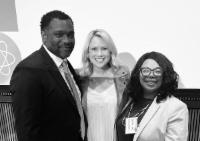
WE’RE was invited to this year’s annual experience summit at Fred Hutch Cancer Center, hosted by Dr. Paul Buckley, a simple but provocative question anchored the day: “What does it actually take for someone to feel like they belong here?” Keynote speaker Dr. Geoffrey Cohen from Stanford offered a clear answer grounded in decades of research: belonging is not a “nice to have.” It is a core driver of performance, retention, and engagement. When people are uncertain whether they belong, the downstream effects on creativity, risk-taking, and persistence are immediate and measurable. Belonging, in this framing, is not about intention alone; it is about the conditions organizations create to signal that people are seen, valued, and have a future.
One of the most practical insights for leaders centered on feedback. Research shows that critique alone rarely drives change, but when paired with a clear affirmation of belief in someone’s potential, outcomes shift dramatically. This “affirm + challenge” approach works because it establishes a relational foundation first. The takeaway is straightforward but often overlooked: how feedback is framed – and the context in which it’s delivered – matters as much as the content itself.
That same principle applies at the systems level. How an organization names, frames, and structures experiences shapes behavior in powerful ways. Even small shifts in context can influence whether people collaborate or compete, engage or withdraw. For leaders, this raises a critical question: what are the signals, formal and informal, that define how work gets done here?
The summit also underscored a deeply human truth: people need to feel remembered. Research shared during the day showed that even small gestures of acknowledgment can have lasting impact. In workplace terms, this translates to consistent, authentic connection; leaders and teams demonstrating, in tangible ways, that individuals are not invisible or forgotten.
Finally, belonging is sustained not just through relationships, but through systems. Tracking outcomes, examining disparities, and building accountability into organizational practices are essential. Values may bring people in, but it is structure and consistency that enable them to stay and thrive.
WE’RE is grateful to Fred Hutch and Dr. Buckley for convening a summit that reflects the growing sophistication of Washington employers. The message was clear: belonging is built in everyday moments, reinforced through systems, and essential to unlocking the full potential of people and organizations alike.
Research Referenced
Geoffrey Cohen, Belonging: The Science of Creating Connection and Bridging Divides, (W.W. Norton, 2022)
Carter GL et al., “Postcards from the EDge,” BMJ (2005); British Journal of Psychiatry (2007, 2013)
Liberman V., Samuels S.M., & Ross L., “The name of the game,” Personality and Social Psychology Bulletin, (2004)
McKinsey & Company, Belonging, research, referenced in summit proceedings
ERGs Are Not a Culture Initiative. They Are a Performance Variable
WE’RE ERG Spring Summit | Friday, June 26, 2026 | 9:00– 4:00 | Hosted by We Are Washington Employers
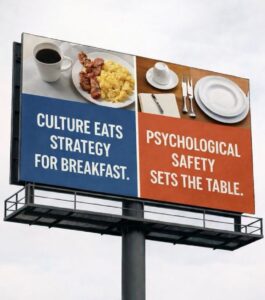
The conversation about Employee Resource Groups has matured and Washington State’s most forward-thinking employers are leading the shift. For too long, ERGs have been positioned as belonging initiatives: important, visible, and chronically under-resourced. The emerging evidence tells a different story. Organizations where ERGs are structurally integrated, connected to executive sponsorship, governance frameworks, and career development pathways don’t just have more engaged employees. They have more adaptive teams, more durable leadership pipelines, and stronger business outcomes. On June 26th. WE’RE is convening the people doing that work.
The WE’RE ERG Spring Summit brings together mid and senior-level DEI practitioners, People Leaders, ERG champions, and HR executives from across Washington State for a full-day working session designed to move the field from conversation to infrastructure. The agenda is built around the questions practitioners are actually wrestling with: What does effective executive sponsorship look like versus symbolic support? How do we connect ERG participation to performance and career growth in ways that are equitable? What governance models are evolving, and what’s falling through the cracks? This is not a conference of keynotes. It is a practitioner room with a working session design, producing accountability matrices, value exchange frameworks, and peer benchmarking tools that participants take home.
The Summit opens with a data-informed landscape overview of where ERGs are thriving and stalling across the Washington employer ecosystem, followed by a candid panel on executive sponsorship as the make-or-break lever for ERG impact. The afternoon turns applied: a focused workshop on the ERG value proposition, how to make the case for member time, organizational recognition, and demonstrated impact and self-selected breakout tracks on governance, equity in labor contexts, and cross-ERG collaboration. Throughout the day, WE’RE facilitators synthesize themes in real time, so participants leave with a shared map of the field and a personal commitment to action.
If your organization sponsors ERGs but hasn’t yet asked how that investment connects to business performance, this Summit is the room to be in. If you lead an ERG and are carrying labor that goes unrecognized and uncompensated, this is the room that names it and builds toward something better. WE’RE’s coalition exists because the conditions for belonging don’t build themselves. They require employers who are willing to design them. June 26th is a day to do exactly that. Registration details to follow space is limited to 10 employees per organization and designed for depth, not volume. We hope to see you there.
American Revolutions: Is the Cognitive Revolution next?
At the end of a recent leadership development session, a participant stayed late to share a genuine fear. She shared, “I think this might be the end of humanity.” She wasn’t talking about war or climate. She was talking about artificial intelligence. I understood the feeling. I also recognized, we’ve been here before. And we survived. We transformed.
Here’s what I’ve come to believe: we are not at the end of something. We are in the early middle of something: a transformation so significant it deserves a place alongside the great revolutions that have already remade American life. Think about what those looked like from the inside.
The Agricultural Revolution upended everything people had known about land, labor, and survival. It displaced centuries of practice. It forced migration, redefined family structure, and restructured entire economies. Terrifying, if you were living through it.
The Industrial Revolution was worse, by most accounts; dangerous factories, child labor, entire trades rendered obsolete overnight. The handloom weaver didn’t just lose a job. He lost an identity. A way of understanding his place in the world. And yet, on the other side of that disruption, we built public education, labor protections, the modern middle class, and an economy that lifted quality of life beyond anything previous generations imagined possible.
The Digital Revolution felt like chaos too. Remember when the internet was going to destroy publishing, retail, social connection, privacy? Some of those fears were warranted. The disruption was real. And yet we adapted, because humans always adapt, and usually toward something better.
Now we are entering what I believe will be called the Cognitive Revolution.
What’s being transformed this time isn’t physical labor, and it isn’t access to information. It’s thinking itself, reasoning, synthesis, judgment, pattern recognition. That is a genuinely new frontier. The stakes feel different because the terrain is different. But the pattern? The pattern is not new.
Every revolution we’ve survived has shared a common arc: fear, disruption, adaptation, and ultimately, a redefinition of what it means to be human at work. We didn’t stop being human when machines took over the factory floor. We didn’t stop being human when algorithms took over the search for information. We won’t stop being human when AI takes over routine cognitive tasks.
In fact, and this is what we told our participant, we may finally get more space to be human. To lead with empathy. To build trust. To navigate complexity with wisdom, not just speed. The capacities that are hardest to automate are the ones that have always mattered most: emotional intelligence, moral judgment, relational courage.
The Cognitive Revolution isn’t coming for your humanity. It’s asking you to bring more of it.
So yes, be thoughtful. Be discerning. Ask hard questions about equity, access, and who benefits from these tools and who gets left behind when speed, not inclusion or insight, is the driver. Those are real and urgent questions that deserve serious attention. But fear? Fear is not a strategy; it’s an emotional reaction rooted in our primal brains.
Every generation that lived through transformation had a choice: to resist the change or to help shape it. The leaders who shaped it, who asked how do we bring people with us, how do we build something better on the other side, those are the ones history remembers. Which side of this revolution do you want to be on?
April 2026