February Newsletter
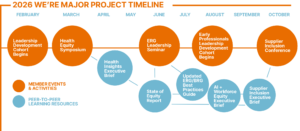
February is already reminding me how much possibility lives in collective leadership. This month, we proudly welcomed Cohort 4 of WE’RE’s Leadership Development Program, which kicked off at Seattle University. In case you don’t know, it is an inspiring group of mid-to-senior leaders representing seven coalition organizations and communities across Washington State. Their energy, curiosity, and commitment to leading with clarity and cultural awareness set the tone for the year ahead. This work is for everyone and equips people with the skills needed to work across all types of settings and at any point in their careers, resulting in greater satisfaction navigating professional and interpersonal spaces. We’re also expanding our leadership development pipeline offerings for members this year with the addition of an Early Career Leadership Development Cohort (taking place August–November 2026), ensuring emerging professionals have access to ethical, inclusive, and future-ready leadership development skill building earlier in their careers.
Beyond leadership skill-building, our work continues to center on belonging as a strategic imperative, from convening employers to address women’s health gaps in the workforce, to tracking a complex 2026 legislative session, to creating trusted spaces for health equity dialogue that will continue this March.
Finally, as a gentle reminder that we are offering roadshow presentations on our new strategic plan and direction for WE’RE. We hope you will find time to attend one or more sessions we are offering weekly through March. In moments of uncertainty and debate, our coalition remains grounded in what we know to be true: belonging strengthens people, workplaces, and communities. Thank you for your contribution to this work with us.
Shirline Wilson
Executive Director, WE’RE
Shirline@wearewere.org.
WE’RE 2026 ROAD SHOW
WE’RE’s Roadshow is a series of live, interactive sessions, designed to give you a clear preview of the year ahead. During these one-hour conversations, we’ll walk through our 2026 roadmap, highlighting upcoming learning opportunities, leadership development cohorts, and key moments for engagement across the coalition. Most importantly, these sessions are a chance to connect, to ask questions, share what’s top of mind for your organization, and identify the touchpoints that will be most meaningful for you and your teams in the coming year. We’d love to have you join us through the linked dates below or get a quick preview here.
Remaining Roadshow Dates Include:
Honoring Black History Month and Beyond
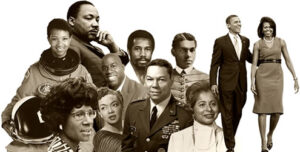
The WE’RE coalition is at the heart of our commitment to leadership, belonging, and equity; not a seasonal focus, but a through-line that shapes our values and our work year-round. February invites us to honor Black history as an integral part of American history. It allows us a moment to recognize Black leaders, organizers, caregivers, and culture-shapers whose courage and imagination expanded democracy and opportunity in this country, often at great personal cost, from the earliest resistance to slavery through the ongoing fight for civil rights, health equity, and voting access. Their sacrifices benefited every marginalized group regardless of gender, race, ethnicity, or national origin.
This year, we face the complication and compounding intersections that can obscure hard-won progress. Across the country, efforts to recognize Black history and address inequity are being framed as political, polarizing, or expendable. Naming this backlash matters, not to give it power, but to be honest about the environment many leaders who care about improved outcomes are navigating. In times like these, we need a steady hand, a clear head, and coalition alignment around our shared principles and priorities. The principle is that recognizing Black history does not divide; it advances truth, resilience, integrity, and shared responsibility.
As Dr. Maya Angelou reminded us, “We are more alike, my friends, than we are unalike.” That truth is not naïve, it is instructive. It calls us back to our shared humanity and challenges leaders to act with clarity and courage, even when doing so feels uncomfortable.
Black History Month also reminds us that progress has always required both landmark action and everyday leadership. While laws like the Civil Rights Act shifted the nation’s legal landscape toward correcting historical injustices for the long oppressed, we needed the daily decisions that followed, such as who is hired, who is heard, who is protected, and who is invested in to determine whether a more equitable outcome could be realized.
Congressman John Lewis called the fight for Civil Rights in America “the struggle of a lifetime,” and it was through his words, deeds, and actions that he lived within the integrity that exemplified the generational role he had to play.
It is our endeavor at WE’RE to responsibly create space for members who take their role in history seriously and are ready to step into the arena where behavior and actions matter. At WE’RE, we are creating the space across our opportunity zones of inclusive workplace culture, building resilient supplier pipelines, and supporting change leader development.
Across our Leadership Development Program and our new Early Career Leadership Cohort, leaders from across Washington State are building the skills required for this moment: emotional intelligence, mindfulness, self-compassion, mentorship and sponsorship, negotiation, and inclusive leadership. These are not “soft” skills; they are essential competencies for creating workplaces where Black professionals and other historically marginalized communities can thrive. Participants practice navigating hard conversations, examining bias, and building cultures of trust and accountability in real time. In doing so, they honor the legacy of those who fought to open doors by committing to keep those doors open, and to widen them, for the future.
As we mark Black History Month, I invite our coalition to see February not as a conclusion, but as a launchpad for exploration and curiosity about the significance of this moment. In Washington State, that might mean amplifying Black voices within your organization, protecting space for honest dialogue about race, health, and opportunity, or engaging locally to translate your values into action by investing in causes that advance equity.
The path forward does not require perfection, but it does require intention. Especially now, inclusive leadership is an act of care and of resolve. When we practice it consistently, not just this month but every month, we move closer to a future where belonging is not aspirational, but lived, and where Black history is recognized not as a risk to manage, but as a foundation on which stronger, healthier workplaces and communities are built.
The State of Health Access
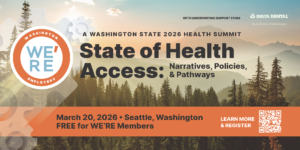
As Washington employers continue to lead in advancing health equity and community wellbeing, our upcoming March 20 gathering at the Seattle Metro Chamber’s Microsoft Center offers a space to connect, reflect, and take action together. This intimate convening will bring together approximately 50 community leaders, practitioners, system changemakers, and corporate partners who share a deep commitment to aligning policy, practice, and investment with health equity goals.
The day’s conversational agenda will invite participants to slow down, listen deeply, and co-create insight around what’s most at risk, and what’s most possible, in health equity right now. From courageous small-group discussions to practical learning from voices like Shirline Wilson, Anna Franklin, and Altrese Hawkins-Gopie, attendees will move from reflection to insight, to relationship, and from ideas to shared responsibility. Whether you’re working in healthcare, education, business, or community development, this is a gathering designed to spark collaboration that lasts beyond the event.
Convening at the Seattle Metro Chamber, the space offers an open and light-filled environment conducive to thoughtful conversation and authentic connection. See photos and floorplan here. Each element of the day, from community grounding and lunch conversations to resilient storytelling and innovation dialogues, has been curated to ensure that everyone leaves with renewed clarity and a network of mutual support
Registration closes soon and March 20 will be here before you know it. If you or someone from your organization would like to join this important conversation, please reach out today to reserve one of the remaining seats. Together, we can continue building a future where equity is more than an aspiration, it’s our shared practice.

Cohort 4 of the WE’RE Leadership Development Program Launches at Seattle University
We’re thrilled to announce the launch of Cohort 4 of the WE’RE Leadership Development Program (LDP) at Seattle University this month. A vibrant new class of mid to senior-career professionals representing seven coalition organizations and industries across Washington State.
As WE’RE’s flagship statewide leadership initiative, the LDP is designed in partnership with Washington State’s leading business schools to equip professionals to lead with clarity, confidence, and interpersonal awareness in an evolving workplace.
What sets this program apart is its real-world curriculum, focused on strengthening emotional intelligence, mindfulness, self-compassion, mentorship and sponsorship, negotiation, and inclusive leadership. Each element is designed for immediate application, empowering participants to build leadership capability while fostering meaningful peer connections.
This year’s cohort is powered by an incredible network of faculty partners – top business school leaders and instructors – who bring research-backed insights, grounded facilitation, and actionable frameworks into every session. Together, they’re helping participants translate learning into live impact across industries and communities.
As WE’RE Executive Director Shirline Wilson shared, “This program is designed to meet leaders where they are; strengthening capability, confidence, and connection in a way that directly supports performance and impact.”
Cohort 4 is already off to an inspiring start, exemplifying what’s possible when leadership development meets purpose, connection, and community.

Registration Now Open: Early Career Leadership Cohort (Aug–Nov 2026)
We’re excited to announce that registration is now open for the Early Career Leadership Cohort, a new strand of the WE’RE Leadership Development Program designed specifically for professionals in their first two years of career experience.
Running August through November 2026, this fully virtual program gives emerging leaders an empowering start to their leadership kickoff, combining foundational skills with real-world readiness. Participants will explore topics like emotional intelligence, mindful communication, negotiation, and inclusive collaboration, alongside a NEW distinct module specifically for this cohort on ethics, etiquette, and generational workplace dynamics, taught by an esteemed Gonzaga University Business faculty, Dr. Rebecca A. Bull Schaefer.
Built for convenience and community, the Early Career LDP cohort will meet weekly online for 12 weeks, providing participants across Washington State with access to expert guidance, peer support, and hands-on learning, no matter where they’re located. Check back soon and learn more about how this experience can help new employees build confidence, competence, and meaningful career connections.
👉 Email Lauren Van Koughnett to learn more.

Recalibrate: Closing the Health Gaps Driving Women Out of the Workforce
We are Washington Employers and the Seattle Metro Chamber recently convened a timely and solution oriented conversation: “Recalibrate: Closing the Health Gaps Driving Women Out of the Workforce.” Facilitated by Shirline Wilson, Executive Director of WE’RE, the event brought together an exceptional panel representing health care, research, and workforce systems: Dr. Josephine Young from Premera Blue Cross; Dr. Estell J. Williams from University of Washington; and Sarah Miller from McKinsey. Referencing A blueprint to close the women’s health gap | McKinsey’s recent report, together explored how women’s health gaps are not only personal and clinical issues, but workforce and competitiveness issues that impact retention, productivity, and long-term economic prosperity.
Grounding the discussion in international research, panelists emphasized that women experience 25% more time in poor health compared to men, and that this burden is concentrated during women’s working years; often while also managing caregiving responsibilities for children, aging parents, and other family members. Panelists shared that closing the women’s health gap could unlock meaningful gains in workforce participation and organizational performance. They outlined three core strategies for employers: comprehensive benefits, workplace flexibility, and prioritizing mental health and cultures of caring. As one panelist underscored, “The science says you can’t afford not to,” reinforcing that women’s health is directly tied to retention, productivity, and long-term workforce stability.
Panelists also offered practical examples employers can implement immediately, including ensuring health plans cover women-specific needs (such as reproductive care and conditions like endometriosis, menopause support, fertility, and family planning); offering non-insurance supports like Employee Assistance Programs and digital health tools to improve access; expanding leave policies to include medical appointments, mental health needs, and caregiving responsibilities; and building flexibility into scheduling for menstruation, pregnancy, postpartum recovery, and menopause. They further highlighted workplace practices that reduce stigma and improve day-to-day support such as providing free period products in all bathrooms, offering wellness and lactation rooms, making fans available for temperature regulation, de-biasing performance and advancement processes (including avoiding penalties after leave), creating support groups or ERGs focused on women’s health (e.g., “Menopause Matters”), and providing benefits training so employees fully understand and use what’s available.
From a healthcare systems lens, panelists challenged employers and institutions to rethink baseline assumptions that many workplace models were built upon. They noted that many workforce norms were designed around a “default” employee experience centered on men, and that simply layering on “patchwork” fixes won’t produce true equity or sustainability. As one panelist shared, “Every workforce in the U.S. was created and centered around the experiences of men,” naming the need for deeper structural redesign rather than incremental accommodations. They also highlighted how change is often delayed even when evidence is clear, stating, “When you have data… it can take upwards of 10 years for implementation to actually occur.” In this view, the moment calls for courageous leadership, honest reflection, and a willingness to recalibrate systems from the root.
From the health plan and employer benefits perspective, panelists reinforced that investing in employee health is not simply a compliance requirement, it is a commitment to whole-person well-being. They emphasized that access isn’t only about what’s offered on paper, but whether employees can realistically use it in the flow of real life. “Just because we offer it, does it mean they can actually get to it?” one panelist asked, encouraging employers to pair benefits with the time, flexibility, and cultural reinforcement that make care truly attainable. Panelists also stressed the importance of integrating physical and mental health supports, noting that “we have this artificial separation between mental health and physical health, but this is all part of one body.” Ultimately, they underscored that workplaces that prioritize well-being create the conditions for employees to sustain high performance and long-term contribution, because as one panelist put it, “There are human laws and nature laws. If the speed limit says 60, but there is ice on the road, nature requires us to slow down. We can and should make needed changes.”
Throughout the conversation, the discussion was guided toward actionable employer takeaways, reinforcing that women’s health needs are often invisible, stigmatized, or treated as “personal issues,” even as they shape workforce outcomes at scale. Panelists emphasized that inclusive workplaces are built on trust, dignity, and practical support where employees do not have to “prove” their needs to be respected, and where leaders are equipped to respond with empathy and competence. As the panel made clear, supporting women’s health is not a “nice to have,” it is a workforce stability strategy, a retention strategy, and a leadership imperative for organizations committed to resilience, equity, and long-term competitiveness.

RESOURCE HUB & UPCOMING EVENTS
- LDP Early Career registration reminder for August 2026 Cohort
- March 20 Health Equity Convening reminder
- Next Recalibrate / next member gathering in April
February 2026