March Newsletter
Washington’s business community is navigating a moment of genuine complexity and this month’s newsletter reflects both the weight of that reality and the work being done to meet it. In our recent conversations with employers across the state, a clear pattern has emerged: the economic landscape is shifting. Some organizations are thriving; others are under mounting pressure from tariffs, taxation, workforce constraints, and macroeconomic uncertainty. This K-shaped dynamic means that even in the same industry, companies are having fundamentally different experiences and making fundamentally different decisions. We are hearing from businesses that are quietly expanding operations and headcount outside of Washington, hedging against a policy and tax environment that feels increasingly unpredictable. The state’s B&O tax on gross revenues is a particular pressure point for low-margin businesses, and concerns are growing that personalizing equity and tax debates is accelerating the departure of talent and capital. Meanwhile, financial services leaders describe a market sitting on the sidelines: rate uncertainty, softening consumer sentiment, and affordability pressures are dampening philanthropic commitments and corporate investment alike. And underneath all of it, even in high-performing organizations, employees are carrying real anxiety about the economy, about AI’s impact on their roles, and about what the national conversation on civil rights and workplace equity means for them personally.
This is precisely the environment in which WE’RE’s work matters most. When the external landscape is uncertain, the internal culture of an organization becomes its most durable competitive advantage. This month, we are proud to share the story of our State of Health Access Convening, which brought together cross-sector leaders to confront Washington’s most pressing health disparities, including the growing evidence that health outcomes track closely with income, geography, and race. We feature the transformative work of the Groundwater Institute, which equips business leaders to ask better questions about the root causes of inequity, questions that are more urgent, not less, in a politicized climate. Our ERG Taskforce continues to build the cross-company infrastructure for belonging and shared learning, with our Spring Summit on the horizon. And we take a thoughtful look at why belonging is not a soft value but a strategic one, especially as national debate about civil rights and DEI intensifies. The through line across all of it is the same: organizations that stay grounded in equity, belonging, and shared purpose are better positioned to weather uncertainty and lead meaningful change. We are glad you are in this work with us.
Shirline Wilson
Executive Director, WE Are Washington Employers
Seats are now open for the WE’RE Early Career Leadership Program
partnership with Seattle University, the University of Washington, Washington State University, and Gonzaga University. All sessions are held Thursdays from 4:00–6:00 p.m. The program is intentionally designed for early career professionals to build five core professional competencies: (1) mentoring, networking, and sponsorship; (2) mindfulness, self-care, and compassionate leadership; (3) professional negotiation principles and practices; (4) emotional intelligence: self-awareness, and relationship management; and (5) workplace generational dynamics and business ethics. The program concludes with a culminating action plan for lasting impact. Now in its fifth year, WE’RE has a proven track record of developing the whole leader, not just professional skills, but the self-awareness and relationships that sustain a career. If you have emerging leaders ready to grow, reserve their seat now. Enrollment is limited to 50 participants.
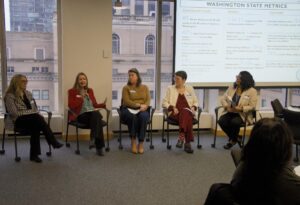
A Room Built For The Moment: State of Health Access Convening | March 20, 2026
On Friday, March 20, We Are Washington Employers convened leaders, practitioners, and advocates from across sectors for a day of honest conversation about the state of health access in Washington. Sponsored by Delta Dental of Washington, the gathering brought together voices rarely in the same room and the result was something worth naming. Across a plenary panel, expert presentations, and facilitated working sessions, participants moved from data to dialogue to possibility, surfacing the shared challenges and emerging collaborations that will shape this work in the months ahead.
The State of Health in Washington: A Closer Look
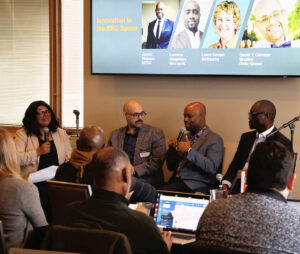
The opening plenary featured leaders from McKinsey, the American Diabetes Association, the American Heart Association, and Delta Dental of Washington, each bringing data and perspective on what health access actually looks like across the state. While Washington ranks 7th healthiest in the nation in 2026, the panel made clear that statewide rankings can obscure deep and persistent disparities. Approximately 20–30% of families report unmet basic needs such as housing, food, transportation, and Medicaid remains a critical lifeline, covering 35% of births, 59% of nursing home costs, and serving 1.86 million residents. Heart disease and stroke remain leading causes of death, diabetes risk is significantly elevated among lower-income populations, and oral health trends are worsening, with untreated decay rising to 19% overall and disproportionately affecting Native Hawaiian and Pacific Islander children. The panel grounded the day in what the data makes undeniable: health outcomes in Washington are inseparable from income, geography, and race and the path forward requires prevention-focused, community-informed, and equity-centered approaches.
AI and Healthcare: Innovation With Integrity
Altrese Hawkins-Gopie delivered one of the day’s most thought-provoking presentations, examining the promise and the peril of artificial intelligence in healthcare. AI holds genuine potential: earlier diagnosis, personalized treatment, expanded access, but Hawkins-Gopie challenged attendees to look beneath the surface. Drawing on historical and contemporary examples of bias and mistrust in healthcare, she demonstrated how disparities can be embedded at every stage of AI development, from the data used to train models to the populations on which they are validated and deployed. Her message to leaders was direct: ask equity-focused questions, measure outcomes across subgroups, and build accountability into governance from the start. Innovation designed without intentionality will replicate the inequities it claims to solve. Innovation designed with equity at its core has the power to change that.
The Village of Care: Trust as Infrastructure
Anna Franklin of Maji Rising offered a vision of healthcare transformation that begins not with systems, but with relationships and community engagement. Drawing on three years of deep community listening, Maji Rising positions itself as a bridge between community wisdom and institutional healthcare demonstrating that culturally rooted, trust-driven approaches increase engagement and improve outcomes in ways top-down solutions rarely do. After facing setbacks in launching a permanent clinic, the organization pivoted to immediate, community-informed services including “Healthcare as a Block Party,” delivering accessible, joyful, co-located care that met urgent needs while deepening trust. Their broader vision, a “Village of Care” model integrating healthcare, housing, education, financial services, and cultural healing, reframes trust not as a soft value but as essential infrastructure. Franklin’s presentation was a call to cross-sector partners, investors, and policymakers: these community-rooted models are not pilot projects, they are blueprints for systemic change. We were all inspired by the blueprint laid by Anna Franklin.
What Comes Next
The conversations that began on March 20 are meant to continue. A video highlight from the convening will be featured in our April newsletter; make sure to watch for it. In the meantime, the planning workgroup will reconvene to review participant feedback and determine meaningful next steps. There is clearly an appetite to build on what this day started, and we intend to.
Save-the-Date: ERG/BRG Spring Summit: Friday, June 26, Seattle, WA
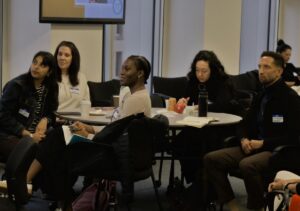
ERG work is maturing and the people doing it are hungry for connection, peer learning, and shared tools. Across organizations, leaders are wrestling with the same complex questions: how to compensate ERG contributors fairly, how to demonstrate measurable impact, how to manage change without losing momentum, and how to build belonging that goes beyond the “pizza party phase.” What emerged from the conversation was not just a set of shared challenges, but a genuine appetite for the kind of cross-company collaboration that WE’RE is uniquely positioned to facilitate.
Three themes anchored the recent ERG Taskforce discussion. One on incentives and equity, organizations are taking varied approaches, some offering quarterly bonuses or cash rewards for ERG leaders, others relying on development opportunities and recognition, while high-billable and unionized environments introduce added complexity around time, compensation, and equity between employee groups. Second, several participants are investing in data infrastructure to track ERG membership against retention, promotion, and engagement outcomes, building the business cases that earn internal investment. And third on ERG maturity and change management. Leaders shared that ERGs within the same organization can be at vastly different stages, and that structured change management, including stakeholder surveys, phased communication plans, and consistent messaging around reciprocity, belonging, and measurable impact is what separates programs that sustain from those that stall. Across the board, there was strong enthusiasm for cross-company collaboration: regional events for women’s groups, Black and African-heritage groups, and joint heritage-month programming, all anchored in trust-based space where internal practices can be discussed candidly.
To support that collaboration, WE’RE is building a confidential directory of ERG groups and leader contacts across participating organizations, a resource designed to enable cross-company networking, joint programming, and real-time peer problem-solving. If your organization would like to be included, please send your ERG group names and point-of-contact information to lauren@employers4equity.org. All information will be kept confidential and shared only among participating WE’RE member organizations.
Looking ahead, mark your calendars for the WE’RE ERG Spring Summit to be held Friday, June 26, 2026, in Seattle. Please socialize the date with colleagues and begin thinking about what you’d most like to explore together. We’re considering anchoring the summit around a themes on the ERG Value Proposition and Executive Sponsorship, and we welcome your input as we finalize the agenda. This is your summit, and the more voices that shape it, the better it will be.
Getting to the Root: The Groundwater Institute’s Approach to Systemic Change
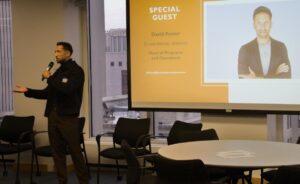
What if the persistent problems we try to fix on the surface, like racial disparities in education, health, housing, and criminal justice, are symptoms of something deeper in the “groundwater”? That’s the powerful metaphor driving the Groundwater Institute’s 1.5-day immersion program, now transforming leaders across Washington state and the nation. Through a data-driven experience, the program reveals how inequities follow the same patterns across all “lakes” (systems): “If one fish has a problem, you might blame the fish. If half the fish in the lake are dying, you will check the lake. If half the fish in every lake are dying, check the groundwater.” Groundwater leaders Bay Love and David Foster emphasize moving beyond blame to re-engineer root causes, power dynamics, and structures that connect these systems, so leaders can build coalitions for lasting change.
Co-founder Bay Love puts it plainly: “If you keep trying to fix the fish when you have a lake problem, you just won’t get very far.” The Institute’s work moves leaders beyond blame into systems-level understanding. Participants engage in data-driven analysis comparing outcomes for people and groups across education, health, housing, and criminal justice. Bay shared, “Racial inequity didn’t exist in any single system or lake: it existed in all of the lakes and looked quite similar across all of those different lakes.” As David explains, “Systems are not performing well or close to equally for everyone, even preventing many from being healthy and reaching their full potential. Through this program we help leaders look at the root causes and re-engineer our systems so they work better for everyone.”
Through a grounding in historical context, participants see how power, influence, and relationships operate today, not as isolated forces, but as long-standing patterns across institutions. That perspective creates space for productive dialogue across differences, where leaders surface new insights about how their own organizations contribute to, and can help shift, those patterns. Bay adds, “We’ve got to understand that broader context to have any hope of doing effective work in any one of those lakes.” When leaders grasp that the groundwater is the same whether it’s observed in school discipline, policing, or healthcare access or outcomes, they begin asking different questions: about power, policy, and who benefits from the status quo.
Delta Dental of Washington was introduced to the Groundwater Institute through WE’RE and joined the journey as a committed partner. CEO Mark Mitchke anchored the organization in a compelling question: “How do we get to our 2035 goal where all people have oral health in Washington?” For Diane Oakes, Delta Dental’s Chief Mission Officer, the Groundwater Institute’s framing made the challenge clear. “While overall oral health has improved with interventions such as community water fluoridation and early childhood dental visits, the disparity by race and ethnicity has held constant. So why is that?” The partnership addresses root causes, ensuring health equity efforts are systemic, not symbolic. Diane notes, “We were drawn to partnering with Groundwater around the racial inequity work to address the root causes.” Through the immersion, Delta Dental deepened its commitment beyond the dentist’s chair, recognizing that “Safety is a big part of what is needed for people to access healthcare. If safety is diminishing, our mission is diminishing.” This has expanded their focus to interconnected social drivers of health: housing, nutrition, transportation, and community safety.
Seeing firsthand the impact of this work, WE’RE is proud to elevate this partnership and increase proximity to this incredible program. As Shirline Wilson shared, WE’RE’s mission is to help employers understand how equity and inclusion not only reflect our values but also drive long-term success. The Groundwater Institute’s work has helped leaders ask better questions: “It’s not just about what’s wrong with the education system or healthcare, it’s the power dynamics connecting them all.” This insight is critical for business leaders who want to ensure their organizations are working well for everyone and closing gaps, leading the way for societal change.
For employers ready to ask better questions about power and systems, the Groundwater immersion is not just training, it’s transformation. Leaders learn how to see the systems shaping their communities and employees, confront the root causes of racial and health inequities, and build coalitions that share a common diagnosis and can stay together through good times and bad. Co-founder Bay Love grounds us that “Change requires risk, vulnerability and discomfort,” and is imperative for society and organizations to thrive.
Why “Belonging” Matters in a Moment of National Debate on Civil Rights and DEI
As national conversations about civil rights and workplace diversity intensify, recent public statements by political leaders reinforce why intentional efforts to foster belonging are essential in today’s organizations. In a January 12 interview with The New York Times, USA Today reporter David Glasgow highlighted comments by former President Donald Trump suggesting that civil rights laws and DEI policies have “hurt” White Americans and amounted to “reverse discrimination.” The commentary triggered widespread debate about the legacy of the Civil Rights Act of 1964 and the purpose of DEI initiatives in workplaces and educational settings.
This moment underscores a deeper challenge for leaders: how to navigate discussions of equity while maintaining trust and cohesion across diverse teams. Research over decades shows that meaningful belonging at work is linked to higher engagement, lower turnover, and greater psychological safety – all critical drivers of organizational resilience through change. When employees feel included and valued, they are more likely to bring their full ideas forward, collaborate effectively, and withstand periods of stress or uncertainty. Scholars and practitioners alike emphasize that belonging isn’t a “soft” value; it’s tied to measurable outcomes in performance and retention.
Practically speaking, people leaders can take several actions this month to affirm belonging in their workplaces. First, leaders should ensure that communication about equity initiatives clearly connects to the organization’s mission and shared goals, framing inclusion as a strength that expands collective capability rather than a zero-sum contest. Second, creating structured opportunities for diverse voices to be heard, such as inclusive leadership forums or cross-functional listening sessions reinforces that every individual’s contributions matter. Finally, anchoring performance conversations in transparent criteria and equitable access to development supports trust that opportunities are fair and based on merit.
In times when public discourse becomes polarized and claims about reverse discrimination gain traction, workplace leaders play a unique role in shaping cultures grounded in respect, dignity, and shared purpose. Highlighting evidence-based practices and centering belonging as both a moral and strategic priority enables organizations to move beyond debate to actionable change, advancing not only equity but performance and organizational health.
Adapted from David Glasgow, “Trump says DEI, civil rights policies hurt White people. Do they?” — USA Today, January 12, 2026. And featured on NYU Law Center on Belongin

Resource Hub & Upcoming Events
Stay Connected. Stay Competitive.
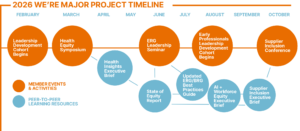
- Next Recalibrate: Know the Facts, April 23, 2026 (virtual)
- Employee Resource Summit, June 26, 2026 (in-person)
- LDP Early Career Cohort, August-November (virtual)
- Supplier Inclusion Conference, October 2026 (in-person)
- LDP Mid-Senior Career Cohort, Feb.-April 2027 (hybrid)
March 2026