November Newsletter
Moving Forward Together: Progress Across Washington Workplaces
This November newsletter highlights how WE’RE is staying focused on its 2030 commitments by strengthening leadership access, building belonging, and growing partnerships with diverse suppliers. It also offers a clear look at the current DEI landscape, noting where some companies are pulling back and where values-driven work is holding steady.
It shares updates on statewide progress, including rising supplier diversity spending, the new early-career leadership cohort, and strong engagement at the recent Employee Resource Summit. The issue closes with a spotlight on Altrese Hawkins-Gopie’s talk on responsible AI and how ERGs can help organizations use emerging technology in ways that support equity and people-first decision making.
Upholding Our 2030 Commitments Through Purpose and Persistence
As November has us turning to gratitude and reflection, it also offers us an opportunity to recommit to the bold vision that WE’RE has set out to be: building inclusive workplaces and supplier networks that ensure economic opportunity for all by 2030. Even through the headwinds we face now, our “Commitments to Progress” remain not just aspirational, but essential to Washington’s future strength.
The coalition Commitments are clear. We committed to expand leadership access and employment pathways; deepen belonging within our organizations; and using our collective power to unlock economic mobility through partnerships with new and diverse suppliers. These are not side projects, they’re core to how we build resilient, competitive businesses that strengthen all of Washington.
Evidence supports that we are on the right course. Companies that center inclusion outperform, driving innovation, reducing risk, and cultivating trust with clients, communities, and employees. By growing our investments in minority-owned, women-owned, veteran-owned, and other historically underrepresented businesses, we’re strengthening our supply chain, deepening community ties, and positioning our organizations for long-term growth.
As a coalition of committed companies, together WE’RE has established structured initiatives to move the needle: from our Leadership Development Program, to collaborative Supplier Engagement, to Employee Resource-Group network skill building and network strengthening.
In the season of thanks, let’s refresh, renew, and sustain our pledge to grow in our commitments for the future vitality of our businesses and the communities we serve and work in. Together, we can build a Washington community and economy that truly reflects the promise of “opportunity for all.”
For questions, please reach out to Shirline@wearewere.org.
Onward,
Shirline

Beyond the Backlash: What’s Really Happening with Corporate DEI
In a recent Washington Post article, national experts weighed in on the shifting landscape of corporate DEI as critics claim victory and companies recalibrate their public commitments. While some organizations have quietly scaled back programs, others are facing scrutiny for doing so, revealing just how complex and politically charged this moment has become. As DEI strategist Livingston Abrams noted, “There’s a fundamental misunderstanding that DEI was a branding technique as opposed to a values system. You can certainly change your branding, but you can’t change your values without it having a resounding effect.” His point underscores a growing tension: companies can adjust messaging, but walking away from the important work of equity and inclusion risks undermining culture, trust, and long-term business credibility.
The article highlights that many companies have already made significant internal shifts, including cutting bias training, reducing supplier diversity goals, and moving away from workforce representation commitments. Yet according to Luke Hartig, president of Gravity Research, the wave of rollbacks has slowed considerably as employers await clearer federal enforcement. He notes that while some recalibration has occurred, there is a limit to how far companies can retreat without real cultural consequences. As Hartig puts it, “I don’t see a lot more adjustments that companies can make,” pointing to the reductions already underway.
Despite the current pressure, experts believe this moment represents a pause and reflection, not a permanent reversal. Hartig anticipates a future correction, saying that the “pendulum” will likely swing back, “if not toward the strong pro-DEI days of 2020 and 2021, then at least toward something a little more moderate.” For employers, this means the long-term question isn’t whether DEI returns, but how organizations choose to evolve in ways that balance legal clarity, business needs, and the persistent demand from employees and consumers for workplaces rooted in equity, representation, and meaningful action.
Supplier Inclusion & Domestic Investment
Strengthening Local Supply Chains for a Stronger Washington Economy
Washington State is making meaningful strides in supplier diversity, but recent data shows there’s still room to grow. In Fiscal Year 2024, the state spent $308.2 million with OMWBE-certified diverse businesses, which represented 3.76% of eligible state spending, up from 3.21% in FY 2023.
When we say “diverse” suppliers, we define this as businesses that are at least 51% owned by historically underrepresented groups: minority-owned enterprises, women-owned businesses, veteran-owned companies, and small businesses certified through WA’s WEBS system (including micro-businesses).
Using data by OMWBE, we see a breakdown of the FY 2023 spend by industry further highlights where inclusion is making inroads: of the $253.5 million in certified-business spending:
- Construction accounted for nearly 48% of that total.
- Professional services (including architectural & engineering) made up about 16%.
- Business operations and management consulting comprised roughly 10%.
- Medical/health was also about 10%, and communications around 5%.
The mission is clear that by engaging diverse businesses across these critical sectors, we can strengthen our region’s resilience:
We invite members to explore ways to strengthen these partnerships. Keep an eye out for our Supplier Engagement Conference coming in Fall of 2026.
Workforce Talent Development
Developing Washington’s Next Generation of Leaders
Leadership Insight: Words matter—they shape culture, influence behavior, and signal priorities. Thoughtful communication builds trust, inspires action, and reinforces the values you want your team to embody.
Introducing Our New Early-Career Leadership Development Cohort
We are excited to announce the launch of a second strand of our 11-week leadership development program, designed specifically for new and early-career professionals with less than two years of professional experience. This expansion reflects both the demand we’ve seen from employers and our commitment to nurturing talent at every stage of the leadership journey. With a dedicated cohort of 50 emerging professionals, this program offers a unique opportunity to invest in the next generation of leaders.
As with our flagship program, the early-career strand will be facilitated by distinguished Washington state business school faculty, including experts from the University of Washington, Washington State University, Seattle University, and other academic partners. Participants will engage in a curriculum grounded in mindfulness, self-compassion, inclusive leadership, negotiation, emotional intelligence, and the power of mentorship and sponsorship. New for this strand is a tailored module for early-career professionals focused on workplace ethics, etiquette, and navigating generational differences, practical tools that support confidence and clarity as they grow in their roles.
We anticipate this cohort will fill quickly, and we encourage companies to identify and reserve participant spots as early as possible. Investing in early-career leaders not only strengthens organizational culture today but helps build a more thoughtful, inclusive, and collaborative leadership pipeline for the future.

Peer-to-Peer Insights
Connection as a Catalyst
Fall 2025 Employee Resource Summit Highlights
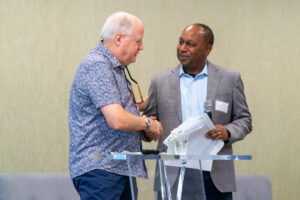
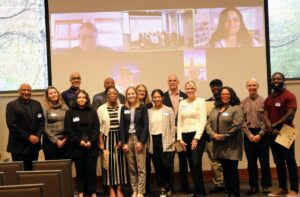
Thank you to all the organizations who joined us, including Microsoft, BECU, Community Leader and Consultant partners, LP, Puget Sound Energy, the Seattle Seahawks, McKinstry, The WA Roundtable, Costco, Greatheart Consulting, ADA Developers, the Gates Foundation, REI, Fred Hutch, Seattle University, Triforza, Farestart, the Seattle Chamber, and Diversity Recruiters.
The summit brought together teams from across the region for a high-energy day focused on connection, learning, and shared leadership. Participants reported an overwhelmingly positive experience, describing the day as timely, purposeful, and energizing, especially in a moment when many ERG leaders are navigating shifting organizational priorities.
This year’s programming struck a strong balance between inspiration and practical skill-building. The AI session with Altrese generated thoughtful conversation about emerging tools that can support ERG operations and storytelling. The fireside chat with Amelia was another standout, offering grounded insight into executive leadership, cultural stewardship, and the real work of influencing systems from within.
Throughout the day, attendees emphasized how much they valued cross-company dialogue. Table conversations surfaced challenges and wins in succession planning, sustaining engagement, and measuring ERG impact. Many shared that connecting with peers facing similar issues was one of the most meaningful components of the Summit.
A number of participants also expressed interest in joining a continuing ERG taskforce, signaling a desire for ongoing statewide partnership and shared learning beyond this annual event. This enthusiasm reinforces the importance of maintaining strong convening spaces for ERG leaders who are shaping workplace culture across Washington.
We extend our thanks to everyone who contributed to making the 2025 Summit such a powerful gathering. Your leadership and collaboration continue to strengthen the fabric of equity and belonging across our workplaces.

Microsoft’s Altrese Hawkins-Gopie on Response AI and Employee Resource Groups
This special presentation is from the 2025 WE’RE Employee Resource Summit. In this session, we’re honored to feature Altrese Hawkins-Gopie, a Microsoft Responsible AI expert, known for bridging the gap between AI Governance, equity focused innovation and employee communities. Drawing on her work in operationalizing Responsible AI, Altrese offers a unique lens on how ERGs can support organizations in building & using AI ethically and responsibly.
Her guidance helps leaders understand emerging technologies through the lens of people, processes, and cultural impact, and organizational readiness; ensuring that AI adoption strengthens inclusion rather than widening gaps. Her insights help leaders understand not only how AI is reshaping the employee experience, but also how ERGs can guide organizations in using technology ethically, inclusively, and with community-centered impact.
This interactive conversation went beyond theory, offering practical strategies for ERG leaders and employees to integrate AI into workflows without losing sight of equity and cultural awareness. From demystifying AI to exploring its real-world applications, Altrese emphasized that AI doesn’t always replace people; it multiplies their skills.
Watch the full session here https://youtu.be/fIP2GgMJeDM
November 2025