October Newsletter
We Heard You: Turning Insight Into Action
As Washington employers navigate rapid change, one message rings clear: progress takes focus, not just words. Over the past five years, WE’RE has listened closely to what matters most to members, taskforces, and partners. We heard the need for clarity, measurable action, and collaboration that strengthens Washington’s diverse workforce and supplier ecosystem.
This month’s newsletter spotlights how those insights are shaping our collective next phase, from building inclusive supply chains and cultivating future leaders through mentorship, to connecting peers at the upcoming ERG Summit. Inside, you’ll find tools, stories, and events designed to help employers turn commitment into impact and ensure opportunity truly works for everyone.
On the Precipice of Change
Many organizations continue to think about building resilient teams while navigating economic, and social pressures. The workforce is shifting, and expectations are changing in ways that effect what it looks like to pursue opportunity, and make the kind of progress that contributes to a stronger Washington.
At WE’RE, we continue to see that the companies best positioned to sustain long term performance are those who continue to invest in courageous, emotionally intelligent leadership—leaders who can make clear decisions in complexity, manage conflict productively, and build trust across diverse perspectives.
In November, the WE’RE task-force on the workforce delivers the 2025 Employee Resource Group Summit, a dynamic in person convening of leaders who support and sustain these important assets within their organizations. All are welcome, so please see the details below if you would like to register to attend. We are excited to hear from the wisdom of so many member organizations, and plan to walk a way with what continues to gives them hope for the future of the important work they do.
Preparing the workforce and supplier pipelines of the future requires your thoughts and ideas. We invite WE’RE members to join a subject matter task force on Supplier Inclusion or Workforce Talent Development to become an architect in the next phase of advancing the Commitments to Progress. If you are an interested subject matter expert in talent development, HR, Supplier Engagement, or Procurement, reach out to Shirline@wearewere.org to set up a 30 minute information session.
Onward,
Shirline

We Heard You
Over the past five years, Washington employers have navigated shifting social and economic headwinds while staying rooted in a shared belief: a successful Washington future includes everyone. Through roundtables, taskforce discussions, and one-on-one CEO feedback, we’ve listened closely to what matters most to our members as we enter the second half of our statewide commitment to progress. The message is clear: progress requires focus on the work, not just words.
From CEOs, we heard a call for clarity and sustained collaboration. Leaders want WE’RE to continue convening a statewide network of employers invested in building a resilient workforce and supplier ecosystem that reflects Washington’s full range of people, perspectives, and talent. They emphasized the importance of developing the workforce our future demands, through shared learning, peer engagement, and leadership development programs that strengthen organizational capacity, agility, and belonging.
From members, we heard the need to move from frameworks to tangible action. Employers are looking for practical tools and shared approaches that make inclusion part of everyday operations.
From closing pay gaps to strengthening supplier networks and talent pipelines that last, members want to see the progress we’ve made as a community reflected in durable practices that can be applied and sustained across sectors.
From our taskforces and partners, we heard a commitment to deepen collaboration and align efforts across three critical pillars: supplier diversity, workforce talent development, and peer-to-peer connection. These working groups reinforced that inclusion is not a siloed initiative but an economic imperative, one that underpins Washington’s competitiveness, innovation, and leadership strength. They’ve asked WE’RE to serve as both a convener and a catalyst, bringing together business, academia, and community voices to sustain momentum through 2030 and beyond.
As we enter this next phase, WE’RE is focused on translating this collective feedback into continued action, amplifying employer voice, strengthening the domestic workforce and supply chain, and leaving behind durable tools, research, and partnerships for the next generation of Washington employers. Together, we are shaping a resilient, inclusive economy that ensures opportunity truly works for everyone.

Peer-to-Peer Insights
Connection as a Catalyst
ERG Keynote Spotlight: Amelia Ransom
We are proud to welcome this year’s ERG facilitators and participating organizations, including BECU, Costco, Gonzaga University, GreatHeart Consulting, McKinstry, Microsoft, Puget Sound Energy, REI, The Gates Foundation, The Seahawks, The Seattle Chamber, and more. These employers are not only advancing ERG innovation but also fostering the community that makes this Summit impactful. Be sure to register to join us on Friday, November 14 at Seattle University for a day of learning, connection, and inspiration as we explore what it truly means to build inclusive spaces from the inside out.
As organizations strive to create workplaces that are not only diverse but truly inclusive, we are absolutely thrilled to welcome this year’s keynote, Amelia Ransom, a leader who continues to push the conversation forward. A nationally recognized inclusion strategist, consultant, and keynote speaker, Amelia has helped dozens of Fortune 500 companies reimagine how employee resource groups drive belonging and business impact. We are thrilled to welcome her as the 2025 Employee Resource Summit keynote speaker for her talk, “Are ERGs Supposed to Be Inclusive?”
Known for her candid, research-driven insights, Amelia’s work challenges leaders to think beyond metrics and toward systemic accountability. Her TEDx Talk,“DEI and the problem of the white doll dipped,” has inspired thousands to see DEI as a discipline requiring consistency, feedback, and personal responsibility. In her widely circulated LinkedIn article, “Diversity work is like working out – you have to do your own squats,” Amelia explores how companies can balance authenticity and alignment in their inclusion strategies, a theme that resonates deeply with this year’s Summit focus on employee-led culture transformation.
Across her body of work, including pieces such as “If You Want to Improve Diversity, Stop Asking Me to ‘Meet You Where You Are’” and “How to Evaluate Your Diversity and Engagement Programs Using Employee Feedback,” Amelia underscores that inclusion is not an act of goodwill but a matter of organizational design. As she notes, “Progress isn’t about comfort, it’s about commitment.” Her perspective invites companies to see ERGs not as side initiatives, but as strategic levers for equity and innovation. We are thrilled to welcome her for this year event, and will welcome participants to join in the conversation with moderator James Thomas.

Supplier Inclusion & Domestic Investment
Strengthening Local Supply Chains for a Stronger Washington Economy
Insights on Supplier Inclusion: Why It Matters
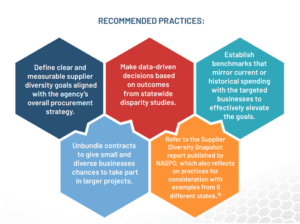
The 2024 Supplier Diversity in State and Local Agencies: Review of Current Perspectives, Policies, and Practices report (commissioned by NASPO and developed by the Simplar Foundation) reveals both progress and persistent gaps in how procurement systems engage underrepresented businesses. While many states have formally adopted goals, those goals are often disconnected from how solicitations, bid evaluation, and contract awards actually function in practice.
If you’re involved in procurement, supplier inclusion, or public policy, this report offers a grounded and holistic view of what’s working and where more work is needed. It goes beyond theory, offering concrete examples, recommended practices, and a lens into how states are navigating the gap between inclusion goals and real-world procurement. Dive into the full text to explore tools states can use to make their contracting more inclusive and to see models that could be adapted or scaled in your own context.
In examining 132 state requests for proposals (RFPs) across sectors like IT, construction, and services, the authors found that explicit DEI criteria rarely carry meaningful weight in evaluations. Even when such criteria are included, they often pale in comparison to cost or technical scoring.The report also spotlights a variety of practices states are using, such as contract unbundling, set-aside programs, and compliance tracking, to improve inclusion in contracting.
One of the biggest hurdles includes ensuring that diverse suppliers included in proposals follow through on their commitments. The report urges stronger monitoring, clearer definitions of “good-faith effort,” and better data systems to track progress at both the individual project and programmatic levels. It also showcases case studies from states like Massachusetts, Minnesota, and Oregon – states that have central dashboards, supplier directories, and outreach programs that bridge procurement offices with certified businesses.

Workforce Talent Development
Developing Washington’s Next Generation of Leaders
Leadership Insight: “If you feel safe and secure, your brain becomes specialized in exploration, collaboration, and cooperation. If you feel frightened and insecure, your brain shifts to managing fear and self-protection. That’s why great leaders learn to regulate their own state, because the stability you cultivate within, becomes the safety others feel around you.” -Bessel A. van der Kolk, “The Body Keeps The Score”
Mentor–Mentee Spotlight: Growth Through Connection
When two participants joined last year’s Leadership Development Program cohort, they hoped to build confidence in navigating high-stakes conversations. What they didn’t expect was how transformative the mentorship relationship would be. Partners from Puget Sound Energy shared that “reflection and honest feedback can accelerate growth on both sides of the relationship.”
“My mentee helped me reframe challenges as opportunities to practice presence and support authentic growth in others through thoughtful questions,” one mentor reflected. Another member from the 2025 cohort emphasized how cross-sector mentorship fuels innovation: “Meeting with other companies and learning from their leadership values reminds me that leadership is about creating space for others to thrive, and in doing so, we all grow more.”
Their stories reflect what we see across every LDP cohort—leaders learning not just new strategies, but new ways of seeing themselves and their teams.
Learn more about the Leadership Development Program
Company information sessions are now open
As we prepare for the February 2026 Leadership Development cohort, WE’RE invites member companies to schedule an Info Session to explore how this 11-week experience can strengthen your internal leadership pipeline.
Developed in partnership with Washington business schools and delivered by faculty from four universities, the LDP integrates evidence-based leadership tools with training in mindfulness and emotional intelligence, mentorship and sponsorship, and negotiation – empowering mentor-mentee pairs to lead with clarity, resilience, and authenticity.
Company Info Sessions provide a behind-the-scenes look at program content, outcomes, and success stories, along with guidance on how to nominate participants. To schedule a session for your organization, please contact lauren@employers4equity.org.

Tool for Leaders: Practicing “The Pause”
In moments of tension or decision fatigue, leaders often feel pressure to respond immediately. Yet the most effective leaders cultivate the pause – a brief moment to breathe, notice their internal state, and choose a response rather than react from instinct. This skill, known as mental clarity training, strengthens emotional regulation and improves decision-making under stress and fatigue.
Try it this week: before responding to an urgent email or weighing in during a meeting, take a single intentional breath. That six-second pause can shift your nervous system from reactivity to awareness, allowing you to lead with focus rather than urgency.
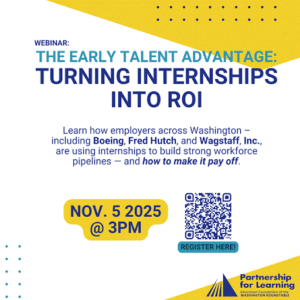
Partnership for Learning Webinar: Internships & ROI
Join Partnership for Learning and a panel of Washington employers at a virtual event on Nov. 5 to learn why companies of all sizes are investing in early talent and how they make it pay off.
Registration is now open for The Early Talent Advantage: Turning Internships Into ROI.
- November 5, 2025
- 3:00 – 4:00 PM
- Virtual
This event will feature employers from across Washington – including Boeing, Fred Hutch, and Wagstaff, Inc.
Why attend?
- Hear from employers across sectors and sizes about how to build internships that strengthen workforce pipelines and deliver ROI
- Learn about different internship approaches and best practices
- Connect with resources and partners that can help
Resource Hub & Upcoming Events
Stay Connected. Stay Competitive.
- November 14, 2025: The 2025 Fall Employer Resource Group Summit
- February 12 – April 22, 2026: The Leadership Development Program
October 2025