September Newsletter
This month’s newsletter marks a season of transition, reflection, and momentum. Inside, we explore how to navigate today’s polarized media landscape and why media literacy matters more than ever, preview our upcoming Recalibrate: Know the Facts conversation on federal policy impacts, and highlight key opportunities for engagement, from registering for the November ERG Summit and securing a spot in the 2026 Leadership Development Program to looking ahead to the Health Equity Symposium next March. We also share new research on the economic power of DEI and resources to help organizations design effective, legally sound inclusion strategies.
POLARIZATION, TRUTH, AND VALUES
In today’s fast-changing world, navigating the media landscape can feel daunting—especially when polarization seems louder than ever. I remain hopeful that when we approach information grounded in facts and guided by values like love, honesty, trust, and humility, we can move past the noise of division and commit to things that bring us together.
This month, I’m delighted to welcome Rachel Smith as the new President of the Washington Roundtable. Washington Roundtable was a founding champion for WE’RE and remains a valuable partner in the advancement of the Commitments to Progress. As we welcome Rachel, we also extend our Steve Mullin, whose years of partnership and vision have helped to shape the WE’RE strategy. We look forward to building on that strong foundation in the years to come.
Looking ahead, mark your calendars for the upcoming 2025 Employee Resource Group Summit on November 14th —a chance to connect, learn, and grow together as we support workplace cultures of belonging. I also need to share an important notice that the WE’RE Leadership Development program 2026 cohort enrollment is already almost full! Don’t wait to secure your spot! Remember, WE’RE members can also join one of our task forces on Supplier Engagement, Workforce Cultures of Belonging, or Washington Business Schools Consortium. For information on that, be sure to email me at Shirline@wearewere.org.
Now is the perfect moment to engage, contribute, and help shape a more resilient and inclusive future for Washington.
Onward,
Shirline

Making Sense of Media in a Polarized Age
In today’s information landscape, Americans are consuming more media than ever before, yet trusting it less. The rise of polarization and misinformation has blurred the line between fact and opinion, making it harder for audiences to find reliable sources. This growing gap in trust has significant implications not just for civic life, but for how communities form opinions and make decisions.
Fortunately, resources exist to help us navigate the noise. Journalist Lisa Remillard’s TED Talk, Media and Democracy: Finding Facts in the Mess of Misinformation, highlights practical steps individuals can take to identify credible reporting. Tools like the Media Bias Chart also provide a visual guide to where major outlets fall on the spectrum of accuracy and political leaning, helping readers approach content with sharper awareness.
PBS journalist Judy Woodruff’s recent series on declining trust and the rise of polarization offers another layer of insight. In this episode, she explores how media fragmentation contributes to division and what it will take to restore faith in institutions. Together, these resources underscore an urgent point: strengthening democracy requires not only consuming diverse perspectives, but also cultivating media literacy as a core civic skill.
As we move into an election season marked by competing narratives and high stakes, the ability to separate fact from opinion will be critical. By leaning on trusted resources, questioning sources, and seeking out balanced information, each of us can play a role in fostering a healthier public square. Taking regular mindfulness and technology breaks is another powerful tool: pausing to clear your mind helps you reset your focus, reduces the risk of information overload, and allows your brain to process more effectively. Just as physical rest restores the body, mental technology rest strengthens critical thinking and decision-making. Stepping away from screens, even briefly for a day or two, creates space for perspective, so when you return to the news cycle, you can engage with greater clarity, critical thinking and resilience.
Recalibrate: Know the Facts – Fireside Chat, October 30, 9am, Seattle Chamber
On October 30, WE’RE, in collaboration with the Seattle Metropolitan Chamber of Commerce, will host its fall Recalibrate: Know the Facts – Fireside Chats, a timely program on how federal policies shape Washington’s economic future. With landmark legislation such as the One Big Beautiful Bill Act and shifting federal budgets, the ripple effects reach every corner of the state, impacting local industries, community organizations, and the workforce. This session will provide context, clarity, and grounded perspectives on what these changes mean for businesses and residents alike.
The program will spotlight sector-specific perspectives, featuring insights from leaders in business, healthcare, and the nonprofit sector. Panelists will share how their organizations are navigating new regulations, reallocating resources, and adapting strategies to remain competitive and responsive. Attendees will gain firsthand perspectives on how policies play out differently across industries—and how collaboration across sectors can help Washington weather transitions more effectively.
Finally, the Fireside Chats will focus on resilience in times of uncertainty. From preparing for economic instability to building organizational sustainability, this conversation will explore how Washington’s leaders are positioning themselves for long-term success. Participants will walk away with strategies for staying grounded in the face of change, a clearer understanding of federal-to-local impacts, and inspiration to approach the coming year with adaptability and confidence.
Register here to join the conversation.
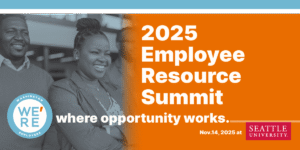
November Employee Resource Group Summit: Registration Now Open
On Friday, November 14, 2025, WE’RE will host the annual Employee Resource Summit at Seattle University. Designed by WE’RE and co-chairs Lorenzo Singletary (Microsoft) and James Thomas (BECU), this full-day, in-person gathering will bring together ERG leaders, champions, and practitioners to explore the evolving role of employee resource groups in today’s workplace. With a focus on leadership, allyship, and innovation, the summit offers ERG leaders the chance to connect, learn, and co-create strategies that strengthen both organizational culture and business outcomes. View event details here.
Highlights include a keynote session on The Future of Belonging and ERGs with Amelia Ransom, a visionary voice on workplace culture, innovation, and intersectional belonging. The program continues with breakout sessions on leadership development, culture shift strategies, and designing intersectional initiatives. A panel of ERG leaders will share what’s working, what’s stalling, and where the next frontier lies, including how to sustain engagement and measure impact. The day concludes with facilitated roundtables to generate actionable insights for the coalition moving forward.
Registration is now open and will close on a first-come, first-served basis. Space is limited to 60 participants, with a maximum of five attendees per company. To ensure broader access, additional virtual coalition events will take place in December and February for those unable to attend in person. We encourage organizations to secure their spots early to be part of this high-value convening.
To support ongoing ERG development, we also encourage members to explore WERE’s growing article repository, an excellent resource hub for ERG leaders and members. Together, these programs and resources reflect WE’RE’s commitment to advancing leadership, innovation, and belonging in workplaces across the region.
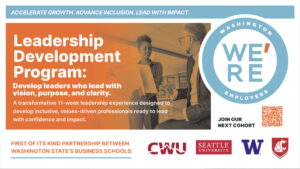
WE’RE’s Leadership Development Program, beginning February 2026 – secure your place today!
WE’RE’s Leadership Development Program is a statewide flagship professional development initiative, created by Washington State business schools to equip emerging and established professionals with the tools to lead with clarity, confidence, and cultural awareness. Rooted in principles of belonging and inclusion, LDP offers a dynamic, high-impact learning environment across industries that supports career growth, collaborative leadership, and meaningful connections. Learn more about the program here including what past program participants have to say about their experience.
Now entering its fourth year, LDP has become one of the most sought-after opportunities for professionals across Washington State and beyond. With a thoughtfully designed curriculum, tailored from four Universities, to meet today’s evolving social, political, and organizational landscapes, participants engage in critical leadership conversations and skill-building sessions. Topics include executive presence, emotional intelligence, mindful decision-making, negotiation, mentorship, and sponsorship—all essential capabilities for thriving in diverse and dynamic workplaces.
Cohort 4, beginning in February 2026, will feature expert faculty, real-time application of leadership frameworks, and the opportunity to learn in community with peers from a wide range of industries and backgrounds. The experience is intentionally designed to be completed in pairs or company cohorts, ensuring that participants have both accountability partners and professional allies to integrate their learning into practice. Together, these elements make the program both personally grounding and professionally transformative.
Seats are limited to the first 50 participants, and registration is filling quickly, with capacity expected to be reached before January. Interested participants should reach out directly to Lauren Van Koughnett to secure a place in this cohort. With demand growing each year, we encourage organizations and individuals to act early to be part of this innovative program that continues to shape Washington’s next generation of leaders.

Health Equity Symposium 2026: From Narratives to Action
A cross-sector steering committee with representatives from WERE, Delta Dental, DH, Fred Hutch, Premera, the Roundtable, and others has begun laying the groundwork for the 2026 Health Equity Symposium. Scheduled for March 19–20, 2026, the event will bring together employers, healthcare leaders, policymakers, and community voices to advance collective strategies for health equity in Washington State.
The two-day symposium is designed to balance accessibility with deep in-person engagement. Day 1 will be hosted virtually, expanding statewide reach and creating space to lift up narratives, share lived experiences, and set the broader context. Day 2 will be held in person at the Seattle Metro Chamber, where participants will move from dialogue to action, co-developing coalition goals and identifying opportunities for aligned advocacy, innovation, and system change.
Agenda highlights include keynotes from leaders with lived and professional expertise, panels on trust-building and systemic accountability, storytelling circles centered on impacted communities, and small-group “Action Labs” where participants will translate insights into coalition goals. The event will conclude with collective commitments and a call to carry this work forward. Together, the symposium aims to spark courageous conversations, elevate equity as a discipline, and equip employers and community partners to act with persistence and shared responsibility. Stay tuned as the event continues to take shape, with registration anticipated to open early in the new year.

What Evidence Shows About the Economic Impact of DEI
In a research rich article, What Evidence Shows About the Economic Impact of DEI, decades of research show the impact of DEI extends far beyond moral or social arguments. In the corporate world, diverse teams consistently outperform homogeneous ones. Studies link workforce diversity to stronger revenue, profitability, innovation, and worker satisfaction. Companies that reflect the demographics of their customers also benefit from increased competitiveness. For instance, nearly two-thirds of U.S. consumers say diversity shapes their shopping choices—particularly younger, female, and racially diverse buyers. When companies ignore these expectations, the financial consequences can be steep: Target, for example, faced a sales decline following backlash when it pulled back its DEI commitments.
DEI’s impact is not limited to corporate strategy, it has historically reshaped education and opportunity in the U.S. Elite universities excluded women until the late 20th century, with Columbia becoming the last Ivy League to admit women in 1982. Since affirmative action, women, especially White women have closed the gender gap and now surpass men in college completion across all racial groups. The desegregation of American universities also fueled an explosion in Black student enrollment, which has risen by 125 percent since the 1970s, more than double the national rate. This expansion of opportunity helped quadruple overall U.S. college enrollment since 1965, creating a better-educated workforce and boosting economic growth.
Immigration policy further demonstrates DEI’s economic ripple effects. The 1965 Immigration Act abolished racial and national quotas, opening doors for immigrants from Asia, Africa, southern and eastern Europe, and Latin America. Many of these immigrants arrived highly educated and have contributed significantly to U.S. productivity and innovation. Today, the evidence is clear: immigrants are a key driver of profitability and growth across the U.S. economy.
While DEI delivers economic returns, it also requires investment and faces growing legal and political challenges. In 2020, U.S. companies spent $7.5 billion on DEI initiatives, and in 2023 the federal government allocated more than $100 million. Yet, in 2025, federal spending is shrinking following executive orders and state-level restrictions on DEI. Critics argue that DEI lowers standards and undermines meritocracy, but a 2023 McKinsey report found the opposite: companies with greater gender and ethnic diversity financially outperform the least diverse by nearly 40 percent. Concerns about lowered standards in science and technology fields are also not supported by research, which instead highlights systemic bias as the real barrier to performance.
The stakes are high. Women and people of color remain more likely to be underemployed and underpaid, with the gender wage gap costing women hundreds of thousands of dollars over a lifetime and nearly $1 million or more for Black and Latina women. Meanwhile, systemic racism has drained an estimated $16 trillion from the U.S. economy since 2000. Closing these disparities could generate $13 trillion in business revenue and create more than 6 million jobs annually. The evidence makes clear that DEI is not simply about fairness—it is about economic strength. In the face of backlash and uncertainty, the challenge ahead is refining DEI to ensure it is grounded in evidence, equity, and measurable impact.
September 2025